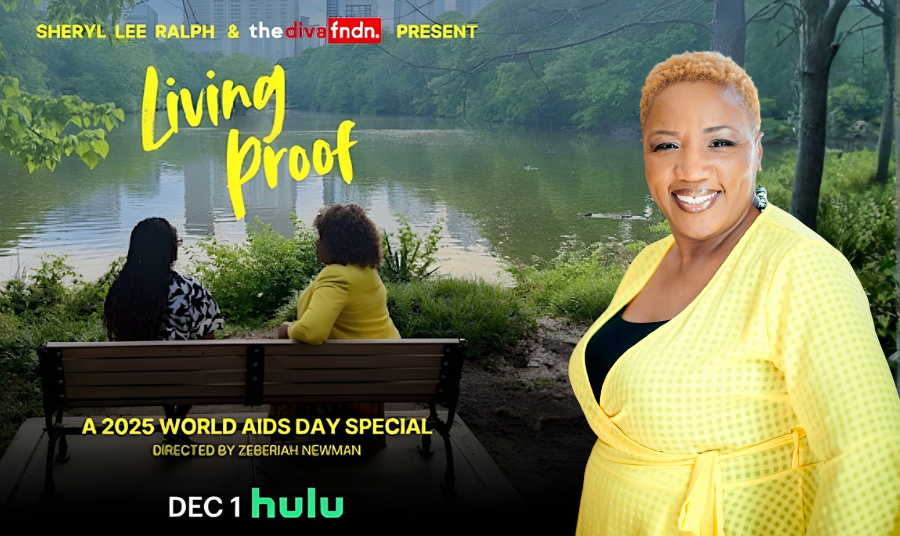
Freda Jones has always led with her heart, a trait that has drastically changed the trajectory of her own life and inspired others in her community to do the same. As she rounds out her 23rd year as an HIV survivor, the patient engagement specialist at AvitaCare Atlanta’s clinic with MedCura Health is seeing her advocacy work gain recognition on a national scale in “Living Proof,” a documentary that celebrates the lived experiences of Black women with HIV. Released on December 1, 2025, in honor of World AIDS Day, the short film is available for streaming on Hulu.
Set in Atlanta — one of the epicenters of the HIV epidemic — the story is described as one of “joy, sisterhood, and self-determination” that “spotlights the systemic challenges that Black women in the South face — including medical discrimination and stigma, as well as the consequences of cuts to public health funding — and how, through support groups, open discussions about PrEP and other community-driven health initiatives, they’re reclaiming their narratives and their health.”
They’re “fighting the good fight and getting into good trouble. They are the face of resilience. They are the voice of joy. They are living proof,” says the documentary’s producer, Emmy-winning actress and activist Sheryl Lee Ralph, about Freda and Kennedi Lowman, co-founders of LOTUS (Loving Ourselves Through Unity and Strength).
Read on to discover how Freda compassionately draws on her lived experiences to guide others through their wellness journeys.
They’re fighting the good fight and getting into good trouble. They are the face of resilience. They are the voice of joy. They are living proof.
Sheryl Lee Ralph
producer of "LIVING PROOF," Emmy-winning actress, & activist
A gut feeling opens the door to HIV advocacy
In 2002, Freda had a gut instinct. “Something in my heart told me that I needed to get tested for HIV,” she says. While she was in a monogamous relationship, her partner kept getting sick. As an entrepreneur and owner of a hair salon, she didn’t really want to take time away from her business. “But I knew I had to do it,” she says.
The problem was that no one wanted to give her an HIV test. “I had to beg the nurse to test me because I didn’t have any symptoms; I wasn’t visibly sick,” Freda recalls. She then had to wait two weeks for the results (a 20-minute rapid test didn’t become available until 2003). “Those were the longest two weeks of my life,” she says.
When her test results came back positive, she approached her partner, who admitted that he knew he had HIV but hadn’t shared that information. Her response could have been one of lasting anger or shame. Instead, what bloomed were the seedlings of HIV advocacy. “I thought, ‘Wow, I need to reach more women,’ Freda recalls. ‘I know I’m not the only professional black woman who has HIV.’”
I thought, ‘Wow, I need to reach more women. I know I'm not the only professional black woman who has HIV.’
Freda Jones
Survivor, advocate,
patient engagement specialist at AvitaCare Atlanta
"Sharing my story felt like it could save someone’s life.”
Immediately after her diagnosis, Freda found a support community where she started volunteering and attending sessions. “During one workshop, the lead support group facilitator asked me, ‘What do you see yourself doing in five years?’ And I said I saw myself doing the work she was doing,” Freda says. She trained for the role, and the following year, she was handed the baton. Dedicating herself to a life of HIV advocacy, she closed her hair salon and became a support group facilitator as well as a part-time mental health and substance recovery coach at another Atlanta non-profit.
“I started sharing my story so that other women could see my face,” Freda says. “But as I got into it, I realized I had something to share with everyone: women, men, Black people, white people, and transgender people. Sharing my story felt like it was helping save someone’s life. People see me and think, ‘If she was at risk of getting HIV, I could be too.’”
I started sharing my story so that other women could see my face. But as I got into it, I realized I had something to share with everyone: women, men, Black people, white people, and transgender people.
Freda Jones
Survivor, advocate,
patient engagement specialist at AvitaCare Atlanta
Helping patients navigate HIV prevention and treatment at AvitaCare Atlanta
In 2008, Freda’s impact on the community widened when she took on the role of patient engagement specialist at AvitaCare Atlanta (formerly AbsoluteCare Atlanta). An Avita Care Solutions company, the medical center partners with MedCura Health to offer compassionate, comprehensive, and inclusive primary and specialized care services to the greater Atlanta community.
In her role at AvitaCare Atlanta, Freda emphasizes the importance of knowing one’s HIV status and getting tested regularly. When it comes to HIV prevention, many women are unaware of a medication called pre-exposure prophylaxis (PrEP) that, when taken correctly, can reduce the risk of HIV infection in people who are HIV-negative by more than 90%. PrEP is available in two forms: a daily oral pill and an injectable.
“Although it’s often marketed more directly to men, PrEP is effective, safe, and viable for women, and should be discussed just as confidently in women’s spaces,” Freda says. “Women need to know they have the right to protect their bodies. PrEP is a form of self-care, a way to take control of your sexual health.”
When she talks to patients newly diagnosed with HIV, Freda immediately tells them two things: how important it is to stay compliant with their medications and to seek support, whether through her or someone else. “I also encourage them to educate themselves about their HIV diagnosis, so they understand that the concept of HIV as a death sentence is a myth,” she says. “You can survive if you want to survive. I remind them, ‘We can do this together.’”
Freda helps patients navigate the emotions that often come with an HIV diagnosis. “Here we are almost in 2026, and I’m still seeing people suffering with secrecy and guilt when they shouldn’t have to,” she says. “I encourage people to advocate for their lives. I tell them, ‘You can live a long, healthy, normal life, but it’s got to be what you decide you want to do.’”
PrEP is effective, safe, and viable for women, and should be discussed just as confidently in women's spaces. Women need to know they have the right to protect their bodies. PrEP is a form of self-care, a way to take control of your sexual health.
Freda Jones
Survivor, advocate,
patient engagement specialist at AvitaCare Atlanta
"There’s life after an HIV diagnosis.”
As Freda celebrated the premiere of “Living Proof” at Emory University’s Rollins School of Public Health in early December, she was pleased to see the diversity among attendees. While colleagues from Emory and Atlanta HIV non-profits SisterLove and LOTUS (groups that work together in the community and are featured in the documentary) attended, new faces eager to learn more about the film’s message also showed up.
“I hope this movie encourages people to get tested and know their status,” Freda says. “I want it to give hope to the newly diagnosed, who might be feeling like they’re not going to thrive. When I decided to be open with my diagnosis, it was because I wanted to help the next person. I want people to see that there’s life after an HIV diagnosis.”
I hope this movie encourages people to get tested and know their status.
Freda Jones
Survivor, advocate,
patient engagement specialist at AvitaCare Atlanta