
As covered entities work overtime to reinvest in patient care amid cascading changes to 340B program policies, federal funding, and healthcare rights for marginalized communities, they’re turning to their community pharmacy partners for strategic support.
Studies show that the most successful 340B pharmacy partnerships are built on a model in which the community pharmacy partner serves as a seamless extension of the covered entity’s clinic. As an ally committed to holistically supporting the covered entity’s goals, the community pharmacy partner must integrate clinical excellence and compassionate patient care with strategic insights that maximize the entity’s 340B program savings.
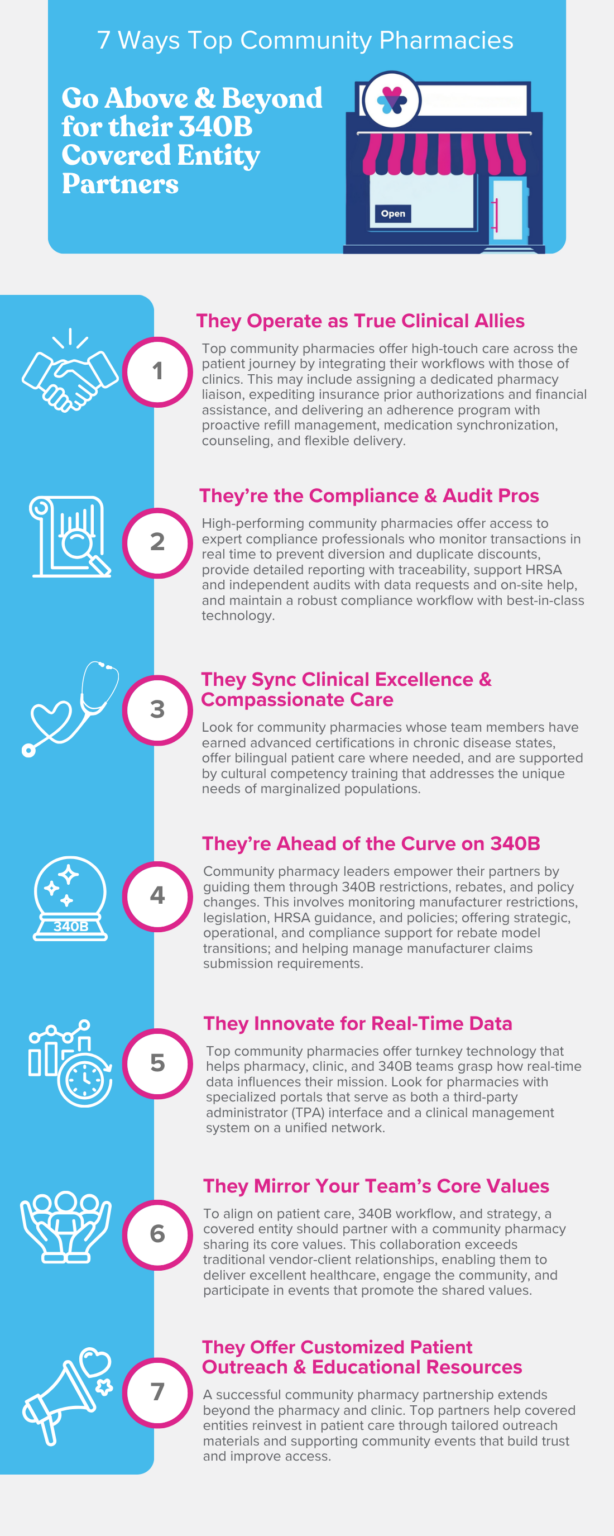
But how does a covered entity know whether a community pharmacy is maximizing its efforts to enhance patient care and future-proof its mission? We spoke with Avita Chief Pharmacy Officer Chris Creamer and SVP of 340B Program Management Cheryl Hetland, who offered seven ways leading community pharmacies go above and beyond for their 340B covered entity partners. Read on for those insights, paired with a handy infographic that highlights the key points.
1. They operate as clinical allies
A pharmacy model focused solely on filling and replenishing prescriptions is not going to cut it in today’s ever-changing world of drug manufacturer updates, patient care best practices, and 340B policy, says Chris Creamer. “The top community pharmacies are offering high-touch, coordinated care across the patient journey by integrating the pharmacy’s workflow with the clinic’s wherever possible,” he explains. “This empowers collaboration across teams, which results in optimized patient care.”
In 2025, Avita Pharmacy piloted its Pharmacy Liaison program at select locations, embedding a dedicated Avita team member as the primary point of contact between the covered entity and Avita teams for questions about claims, eligibility, refills, and patient support. “This consistent communication helps ensure that both teams stay aligned and proactive in supporting patient care,” says Karen Hernandez, a pharmacy liaison at one of Avita’s three onsite pharmacies with partner Valley AIDS Council. “Above all, I make sure patients feel supported and informed — even if they choose not to fill their prescriptions with us.”
Leading community pharmacies are also geared to be proactive, Chris says. They expedite insurance prior authorizations and patient financial assistance to quickly remove barriers to care and make sure patients receive the medication they need. They also offer a dedicated medication adherence program that includes proactive refill management, medication synchronization, adherence counseling, and flexible delivery options. The goal? Patients never miss a dose and achieve the best possible health outcomes.
The top community pharmacies are offering high-touch, coordinated care across the patient journey by integrating the pharmacy’s workflow with the clinic’s wherever possible. This empowers collaboration across teams, which results in optimized patient care.
Chris Creamer
Chief Pharmacy Officer, Avita Care Solutions
2. They’re the compliance and audit pros
High-performing community pharmacies also provide best-in-class, real-time HRSA compliance and audit readiness for their covered entity partners, says Cheryl Hetland. “Growing regulatory scrutiny, manufacturer constraints, and operational complexity increase the risk of noncompliance and erode 340B savings,” Cheryl says. “Community pharmacies with a team of 340B experts can help covered entities strengthen their compliance to protect program eligibility, avoid audit findings and repayment risk, and preserve the drug savings that support patient care and safety-net services.”
With that in mind, Cheryl urges covered entities to look for community pharmacy partners that:
- Regularly monitor transactions in real time to identify diversion and duplicate discounts before they escalate into compliance issues
- Provide comprehensive, transaction-level reporting with end-to-end traceability from prescription through replenishment
- Participate in HRSA and annual independent audits, assisting with data request lists, on-site support, and corrective action plans
- Provide a strong compliance workflow with best-in-class technology
- Offer access to compliance professionals who can assist with investigations, self-disclosures, manufacturer inquiries, and HRSA audits
“At Avita, we view compliance as an ongoing partnership,” Cheryl notes. “Our goal is to help covered entities build sustainable processes that support program integrity, optimize savings, and ensure audit readiness. By collaborating directly with care teams, we help reinforce documentation best practices and ensure the records support 340B eligibility determinations. Strong clinical documentation not only supports compliance but also enhances continuity of care and overall patient outcomes.”
Growing regulatory scrutiny, manufacturer constraints, and operational complexity increase the risk of noncompliance and erode 340B savings. Community pharmacies with a team of 340B experts can help covered entities strengthen their compliance to protect program eligibility, avoid audit findings and repayment risk, and preserve the drug savings that support patient care and safety-net services.
Cheryl Hetland
SVP 340B Program Management, Avita Care Solutions
3. They sync clinical excellence and compassionate care
Leading community pharmacy teams are well-versed in delivering a powerful combination of clinical expertise and cultural competency, Chris says. Look for community pharmacies whose team members have earned advanced certifications in chronic disease states, offer bilingual patient care where needed, and are supported by cultural competency training that addresses the personalized needs of marginalized populations.
For example, “At Avita, more than 70% of our pharmacists have earned their AAHIVP certification from the American Academy of HIV Medicine,” Chris reports. “This fosters the delivery of stigma-free, compassionate care to patients disproportionately affected by complex health conditions.”
Additionally, all Avita team members, including those who are not patient-facing, must complete the organization’s cultural competency training program during onboarding and annual refresh sessions. Because a large portion of Avita’s patients are members of the LGBTQ+ community, the training program was developed in collaboration with The Fenway Institute and frontline LGBTQ+ providers to help team members deliver inclusive, affirming, personalized, and responsive patient care.
Look for community pharmacies whose team members have earned advanced certifications in chronic disease states, offer bilingual patient care where needed, and are supported by cultural competency training that addresses the personalized needs of marginalized populations.
4. They’re ahead of the curve on 340B
Another way community pharmacies can go above and beyond for their covered entity partners is by helping them navigate the evolving landscape of 340B restrictions, rebates, and policy updates, Cheryl says. “Navigating 340B today requires more than expertise,” she explains. “It requires a partner who understands the risks, anticipates the changes, and helps covered entities protect both compliance and program value.”
This includes:
- Providing continuous monitoring of manufacturer restrictions, state legislation, HRSA guidance, and federal policy developments
- Offering strategic, operational, and compliance support to help covered entities successfully transition to emerging rebate models while maintaining program integrity
- Assisting with the management of manufacturer claims submission requirements for ESP, Truzo, Beacon, and other manufacturer platforms
“Successful 340B compliance depends on strong partnerships across clinical, operational, and compliance functions,” Cheryl says. “Through monthly reviews, documentation support, and ongoing collaboration with clinical and case management teams, we help covered entities establish a culture of compliance that supports both audit readiness and program success.”
Worth noting: 100% of Avita’s client-facing 340B team members are 340B Apexus Certified Experts (ACEs), a group of individuals with the most advanced level of 340B knowledge in the industry.
Navigating 340B today requires more than expertise. It requires a partner who understands the risks, anticipates the changes, and helps covered entities protect both compliance and program value.
Cheryl Hetland
SVP 340B Program Management, Avita Care Solutions
5. They innovate for real-time data
The best community pharmacies may treat their patients with good old-fashioned personalized care, but they’re also helping their covered entity partners adopt the latest technology to make data-driven decisions. “Community pharmacies should provide their partners with turnkey technology that makes it easy for the pharmacy, clinic, and 340B teams to understand how real-time data is impacting the organization’s mission,” Chris says.
At Avita, that technology is Avita CareConnect. This specialized portal facilitates digital engagement between Avita and its partners by serving as both a third-party administrator (TPA) interface and a clinical management solution on a single, network-wide operating system. The platform supports patient services and pharmacy management, delivering daily updates that provide real-time visibility into script volume and qualification. The result, Chris says, is centralized patient engagement and data, which empowers clinicians to track missed refills and synchronize activities across the network.
It’s working, says Sandra Vasquez, a social worker with Avita covered entity partner PILLAR, who uses Avita CareConnect daily. “I love that we can easily access settlement reports and track which providers are prescribing which medications,” she says. “Our program has grown by leaps and bounds by helping clients adhere to their treatment plans, monitoring follow-up appointments, and avoiding refill issues.”
Community pharmacies should provide their partners with turnkey technology that makes it easy for the pharmacy, clinic, and 340B teams to understand how real-time data is impacting the organization’s mission.
Chris Creamer
Chief Pharmacy Officer, Avita Care Solutions
6. They mirror your team’s core values
To ensure alignment on patient care, 340B workflow, and strategic direction, a covered entity should partner with a community pharmacy whose core values are similar to its own, Chris says. “At Avita, our core values are compassion, collaboration, and resourcefulness, and they’re foundational to everything we do,” he explains. “They guide us in upholding Avita’s promise.”
This connection has been key to the success of the partnership between Avita and Alamo Area Resource Center (AARC). The relationship between Avita and AARC goes beyond a traditional vendor-client dynamic. They actively support each other, recognizing that their success is intertwined. Together, they provide exceptional health care services, engage with the community, and participate in events that promote their shared values.
To ensure alignment on patient care, 340B workflow, and strategic direction, a covered entity should partner with a community pharmacy whose core values are similar to its own.
7. They offer customized patient outreach and educational resources
A successful community pharmacy partnership is about more than what happens inside the pharmacy and the clinic, Chris says. “The top pharmacy partners will help covered entities reinvest in patient care by offering customized patient outreach and engagement materials and by actively supporting community events that build trust and improve access to care,” he explains.
The Avita team sponsors hundreds of events and local initiatives each year, including a promotional campaign and packed event calendar during LGBTQ+ Pride season. It also provides covered entity partners with high-quality, customized marketing and outreach materials designed to stimulate patient interest in achieving optimal health. In 2026, Avita introduced its “Everybody” campaign, which encourages patients to consider the benefits of HIV pre-exposure prophylaxis (PrEP), shows that HIV prevention isn’t limited by identity, body type, or lifestyle, and reminds patients that everyone deserves care that reflects who they are.
The top pharmacy partners will help covered entities reinvest in patient care by offering customized patient outreach and engagement materials and by actively supporting community events that build trust and improve access to care.
Chris Creamer
Chief Pharmacy Officer, Avita Care Solutions