U=U (Undetectable = Untransmittable), the scientifically proven concept that a person living with HIV who is on treatment and has an undetectable viral load cannot sexually transmit HIV, celebrated its 10th anniversary in 2026. It’s been a decade of deep learning and growth for the movement’s founding organization, Prevention Access Campaign (PAC), bolstered by the campaign’s impassioned supporters worldwide.
As an early advocate for U=U, Avita Pharmacy, an Avita Care Solutions company, stood behind the science when others held back. “We recognized then, as we do now, that sharing the truth about U=U has the power to reduce stigma, strengthen engagement in care, and improve the lives of people living with HIV,” says Avita Chief Advocacy Officer and Prevention Access Campaign Board Member Glen Pietrandoni. “Over the past 10 years, the movement has changed countless lives by replacing fear with facts and uncertainty with hope. We remain deeply committed to ensuring that every person living with HIV has the resources, support, and confidence to achieve lasting health and an improved quality of life.”
While Avita has created customized marketing materials to engage its patients and covered entity partners in the U=U message for years, it’s now taking its outreach efforts a step further. On World AIDS Day, PAC’s Executive Director, Dr. Monique Carry, will deliver a bespoke “Ask Me About U=U” training for the organization’s more than 630 team members, including frontline providers, clinicians, and support staff. The goal: to make it easy for anyone to answer frequently asked questions. The why? “Every interaction is an opportunity to reinforce the life-changing message of U=U, answer questions, address barriers to care, and help patients stay engaged in treatment,” says Glen. “When patients understand that maintaining an undetectable viral load protects their health and prevents HIV transmission, it can transform not only their clinical outcomes but also their confidence, relationships, and overall quality of life.”
We chatted with Dr. Carry to learn more about the U=U movement’s momentum, what’s on the horizon for the campaign, and the meaning behind its World AIDS Day slogan, “The Next 10 Years Starts Now.”

Dr. Monique Carry
Executive Director, Prevention Access Campaign
When someone learns about U=U, they're hearing more than a scientific fact; they're hearing something that will change how they think about their health, their body, their ability to have relationships, and what their future looks like.
10 Years of U=U: A milestone and inflection point
The Avita Blog: Avita has a long history of advocating for U=U and supporting the work of PAC. In 2022, we interviewed founder Bruce Richman to discuss U=U’s sixth anniversary, including how far the mission had come and what work remained. In 2026, U=U is celebrating its 10th anniversary. Explain the movement’s momentum over the last four years. Has the strategy or mission changed at all?
Dr. Carry: This is such a big year for us. Reaching 10 years is a milestone, but also a major inflection point. What struck me most about reaching 10 years is how much has changed, and how much responsibility we still have to get the U=U message out.
When someone learns about U=U, they’re hearing more than a scientific fact; they’re hearing something that will change how they think about their health, their body, their ability to have relationships, and what their future looks like.
Before I go any further, it’s important to recognize Avita’s commitment. Avita stood behind the U=U message early, when many organizations were still hesitant to share it despite the science supporting it. That really matters. It helped make space for conversations people desperately needed to have. When I look back at Bruce’s interview four years ago, I would say PAC’s foundation remains the same. It’s still about sharing the science of U=U and ensuring people have access to care so they can benefit from U=U.
Over the past four years, we’ve built more ways to help our partner organizations do that. These efforts include developing the PAC’s collaboration with the Centers for Disease Control and Prevention (CDC), creating the U.S. Department of Health and Human Services (HHS)-approved U=U implementation resource guide, and piloting and launching U=U University, our online training platform. This year, we developed an in-person, practical training for healthcare teams and community partners. Overall, our strategy is to help people clearly hear the U=U message: that a person living with HIV who takes their HIV medication and maintains an undetectable viral load cannot transmit HIV through sex.
Now we’re asking: How consistently does that message show up in someone’s care? Do they hear U=U when they first come in for testing? Do they hear it when they’re considering or starting treatment? Does their pharmacist reinforce it between visits? When staying in care gets difficult, do they hear it then? That’s where we’re moving with our World AIDS Day message this year, “The Next 10 Years Starts Now.”
We’re so proud of how far U=U has come. Now we want to build on that progress to ensure more people receive the information and support they deserve.

Glen Pietrandoni
Chief Advocacy Officer, Avita Care Solutions
Board member, Prevention Access Campaign
Over the past 10 years, the movement has changed countless lives by replacing fear with facts and uncertainty with hope. We remain deeply committed to ensuring that every person living with HIV has the resources, support, and confidence to achieve lasting health and an improved quality of life.
The momentum behind U=U University and facilitated training opportunities
The Avita Blog: PAC offers U=U training and technical support to organizations worldwide. You’ll present to the entire Avita team on World AIDS Day, and we’ll distribute educational materials at our pharmacies and clinical locations ahead of the event. Tell us about the training and resources you offer and how interested groups can access them.
Dr. Carry: Last year, we launched U=U University online. Through that platform, we offer self-guided courses to help people understand and communicate U=U. You learn the science behind U=U and how to address hesitation. You can also take live, facilitated courses.
We now have a train-the-trainers program to help others learn to teach this content. We also have a community of practice where people can learn, practice, and stay connected in various ways, whether they’re working in a clinic in the United States or supporting a community organization elsewhere in the world.
We also just kicked off our new “Ask Me About U=U” in-person training for healthcare workers. It covers the situations they’ll encounter. We’re excited to bring this session to the Avita team virtually on World AIDS Day. It’s all about how to respond when someone asks, “Can I really believe U=U?” or “How do you respond when a person is worried about their relationships?” or “How do you talk about U=U to someone who is having a hard time staying on treatment?” In this session, we give people time to practice. Afterward, we provide them with tools they can use, including conversation guides and fact sheets.
We’re also excited about our “3 Moments of U=U: Integrating U=U into Status Neutral Care” flipbook, which guides you on how to talk to someone about U=U, from testing to treatment initiation to keeping them engaged in care. We’re helping organizations plan U=U activities, adapt them to their communities, and understand what’s working so we can improve our offerings.
We appreciate what Avita is doing with their World AIDS Day U=U training because it brings your team into the conversation and places these materials where people receive care. These efforts reinforce each other. Everyone should check out our U=U University webpage. People can also reach out to us via email at [email protected]. Tell us what your team needs, and we can discuss a useful place to start and whether the right tools already exist or whether your team will require special adaptations.
Dr. Monique Carry
Executive Director, Prevention Access Campaign
We have a community of practice where people can learn, practice, and stay connected in various ways, whether they're working in a clinic in the United States or supporting a community organization elsewhere in the world.
The advocacy front: Linking U=U to access, treatment, and testing
The Avita Blog: PAC’s advocacy work has a worldwide footprint. In the U.S., PAC has formed the U=U National Task Force, with the U.S. Congressional HIV/AIDS Caucus’ endorsement, in partnership with inaugural members Elton John AIDS Foundation, Equality Federation, Human Rights Campaign, NMAC, Southern AIDS Coalition, and The Well Project. The goal of the Task Force is to ensure that the U.S. government follows through on the commitments outlined in the Multinational Undetectable = Untransmittable (U=U) Call-to-Action (MUCA). Tell me about the success you’ve seen with the Task Force, especially during a time of renewed stigma and decreased funding for HIV prevention, treatment, and research.
Dr. Carry: The Task Force’s value lies in bringing people together to ensure that U=U is not only shared but, more importantly, accessible to those seeking care. When a government commits to U=U, we have to keep asking: What exactly does that commitment entail?
That was the beauty of the multinational U=U call to action, which gave us a framework for those conversations. It links U=U education to access to treatment, care, and viral load testing. People need all of those to benefit from U=U.
In December 2024, the Presidential Advisory Council on HIV/AIDS unanimously passed a U=U resolution. It recommended that the United States follow the call to action and that HHS formally recognize and collaborate with the U=U National Task Force. Following through on that means assessing the changes needed in services, provider education, and access to care. That’s where we must focus, especially now, as communities face uncertainty about funding for HIV services. Our organizations should work toward the same goals.
We want to protect our most vulnerable communities. To be clear, we’re asking that people receive dependable access to their medication. They need trustworthy care and accurate health information. These investments support their overall well-being and help prevent HIV transmission.

Clear, consistent, and inclusive messaging is crucial
Think about how confusing that would be, especially if you had spent years being told to fear HIV. We must give people a message they can understand, trust, and hear consistently. That’s why we’re investing in training through U=U University, our communications training, and practical tools. We want healthcare teams to feel prepared to answer people’s questions about U=U clearly and confidently.
Then there’s access. Even if you understand U=U perfectly, your problems won’t magically disappear if you can’t access medication, arrange transportation, or get to your appointment.
Our education strategy must remain connected to our advocacy work so people can access the healthcare services they need. We’re also preparing facilitators to serve as trusted community messengers and to sustain that momentum.
We also cannot let U=U become yet another way people living with HIV are judged. A person’s worth doesn’t depend on their viral load. If someone hasn’t reached undetectable status or is having difficulty maintaining it, they still deserve care and respect.
As we move forward, the question we should ask is: What support do people need, and how can we help ensure U=U is a reality for everyone?
Glen Pietrandoni
Chief Advocacy Officer, Avita Care Solutions
Board member, Prevention Access Campaign
Every interaction is an opportunity to reinforce the life-changing message of U=U, answer questions, address barriers to care, and help patients stay engaged in treatment. When patients understand that maintaining an undetectable viral load protects their health and prevents HIV transmission, it can transform not only their clinical outcomes but also their confidence, relationships, and overall quality of life.
U=U plus PrEP: The path to ending HIV
The Avita Blog: What is the relationship between U=U and the PrEP advocacy movements?
Dr. Carry: I discussed this topic at the South Carolina HIV, STD, and Viral Hepatitis Conference. My keynote address focused on “We know what’s working; why aren’t we using it?” U=U plus PrEP is the path to ending the HIV epidemic. We have these amazing biomedical tools. We shouldn’t be debating which tool gets more advocacy. They work in tandem.
A key part of our strategy moving forward will be integrating U=U into a status-neutral framework so people understand their options for PrEP and U=U from the start. Knowing this relieves anxiety about HIV testing and learning one’s HIV status, because either way, there’s something for you.
We’re ensuring people understand U=U and that messaging is integrated into prevention conversations. Presenting both options will help us make real progress.
Dr. Monique Carry
Executive Director, Prevention Access Campaign
U=U plus PrEP is the path to ending the HIV epidemic. We have these amazing biomedical tools. We shouldn't be debating which tool gets more advocacy. They work in tandem.
How providers can get the U=U conversation started
The Avita Blog: What can healthcare providers, including clinicians, pharmacists, peer navigators, and others, do to help underserved patient communities better understand the power of U=U?
Dr. Carry: First, don’t assume someone else has already explained U=U to a patient. In most cases, that’s not true. If you’re part of a patient’s care team, start a conversation about U=U.
You can begin by saying, “HIV medication can reduce the amount of HIV in your body to an undetectable level. When you reach and maintain undetectable status, you can’t transmit HIV through sex.” Give the person a moment, then ask, “What have you heard about U=U?” Let their response guide the next part of the conversation.
Maybe they’ve never heard of it. Or maybe they have heard something but received incorrect information. Having that respectful conversation gives them an open opportunity and a safe space to understand how U=U directly applies to their life and goals.
Pharmacists play an important role in this conversation because they see patients between clinical appointments. A refill conversation can now be an opportunity to reinforce U=U, discuss medication concerns, or help address an access issue. Like peer navigators, pharmacists can help people understand their options and navigate services that may feel overwhelming.
We need to examine how we’re delivering information. Are we using language people understand? Are we protecting their privacy? Are we including people living with HIV in shaping that education and in telling their stories? When someone is struggling, are we asking what we can do to make care easier for them? You may learn something that changes how you support them.
You don’t need a perfect speech. You just need accurate information, a willingness to listen to the person in front of you, and a conversation in which the patient feels seen and able to ask questions.
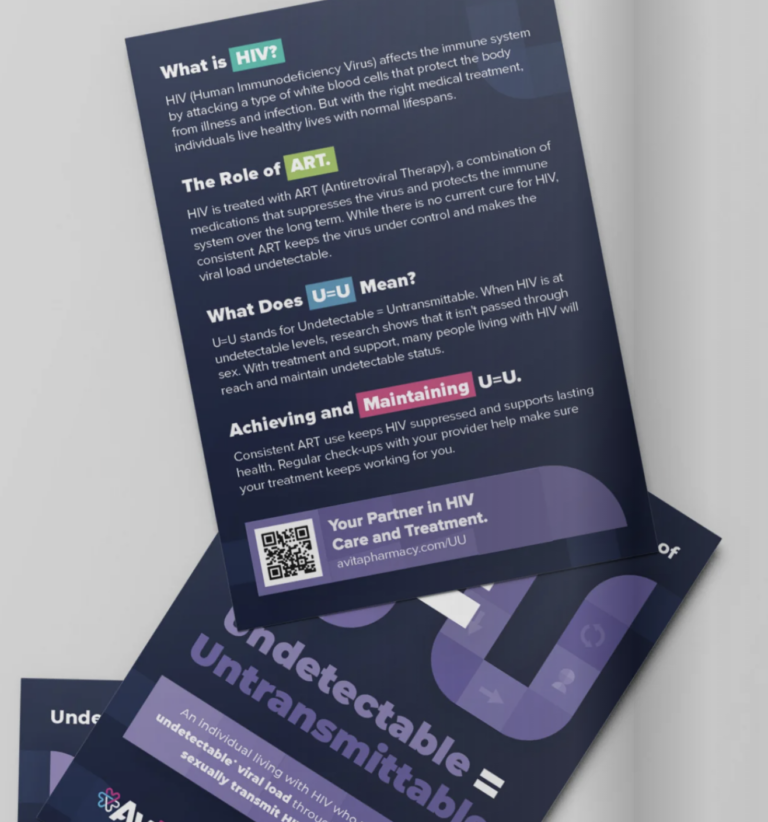
U=U patient engagement materials created for use by Avita providers.
The future of the U=U movement
The Avita Blog: What’s next for the U=U movement?
Dr. Carry: When I think about what’s next, I picture the next person who walks into a clinic or a pharmacy for the first time and hasn’t had U=U explained to them. That person needs to leave with a better understanding of U=U, their health, and someone they trust to turn to when they have questions.
For PAC, this means expanding our U=U University platform, training more facilitators to share information across communities and organizations, supporting our organizational partners, and ensuring that the resources we’ve developed are available in additional languages.
We want organizations to integrate U=U into the care they already provide, so the conversation continues after they attend one of our trainings. We are also working to better understand what happens after the trainings. Are people using the tools we’re developing? Are patients hearing the message now? Where do teams need more support? Where are they having challenges getting the U=U message out?
We’ve listened to that feedback and have consistently improved the tools and resources we’re developing. People living with HIV continue to shape this work. Their leadership built the U=U movement, and their experiences must continue to guide where we’re going next.
Access must remain part of every conversation about our future. We need to identify the biggest barriers to providing care for patients who would benefit from U=U and determine how to overcome them.
What Avita is doing with its U=U training gives us a practical example of how to move people forward. You’re preparing your team, making information available, and creating opportunities to talk with people.
My hope is that 10 years from now, most people will be able to say, “My care team told me about U=U and was there when I needed support.”

Dr. Monique Carry is the Executive Director at the Prevention Access Campaign (PAC), where she spearheads initiatives to expand the global impact of Undetectable = Untransmittable (U=U), including launching U=U University and strengthening partnerships that advance inclusive access to quality care and treatment.
A behavioral scientist and health communications expert with more than 15 years of experience, Dr. Carry has dedicated her career to using social and behavioral science to improve HIV prevention, treatment, and stigma reduction worldwide.
Before joining PAC, Dr. Carry served as the Senior Health Communications and Demand Creation Advisor in the Global Health Center’s Division of Global HIV & TB at the U.S. Centers for Disease Control and Prevention (CDC). As a lead U=U subject matter expert, she provided technical assistance to over 50 PEPFAR-supported countries and authored the definitive CDC/PAC “Implementing and Scaling Up U=U: A Resource Guide.”
She has also developed innovative communication strategies, training programs, and demand-creation initiatives adopted in multiple regions, accelerating the global scale-up of U=U. Her leadership in these areas directly informs the vision and curriculum of U=U University, ensuring it is rooted in science, best practices, and real-world implementation experience.
Dr. Carry’s commitment to achieving parity in health outcomes has been recognized with numerous honors, including the Thomas A. Bartenfeld Excellence in Public Health Practice Award, the CDC and ATSDR Excellence in Frontline Public Health Service Award, the National Center for HIV/AIDS, Viral Hepatitis, STD, and TB Prevention Excellence in Program Delivery Award, the Division of HIV/AIDS Prevention Director’s Recognition Award, and multiple health equity Awards from the CDC and the Agency for Toxic Substances and Disease Registry (ATSDR).
Originally from the Washington, D.C., area, Dr. Carry is a member of Phi Beta Kappa and earned her BA, graduating summa cum laude, from Howard University. She completed both her MA and PhD at Emory University, focusing on how social and structural systems influence health behaviors and outcomes. She is widely recognized for her leadership in bridging research, policy, and community-based approaches to end the HIV epidemic and build trust between health systems and the communities they serve.